2024.06.30

The Lure of Light in the Night

Insects aren't drawn to nighttime illumination for the reasons we think they are

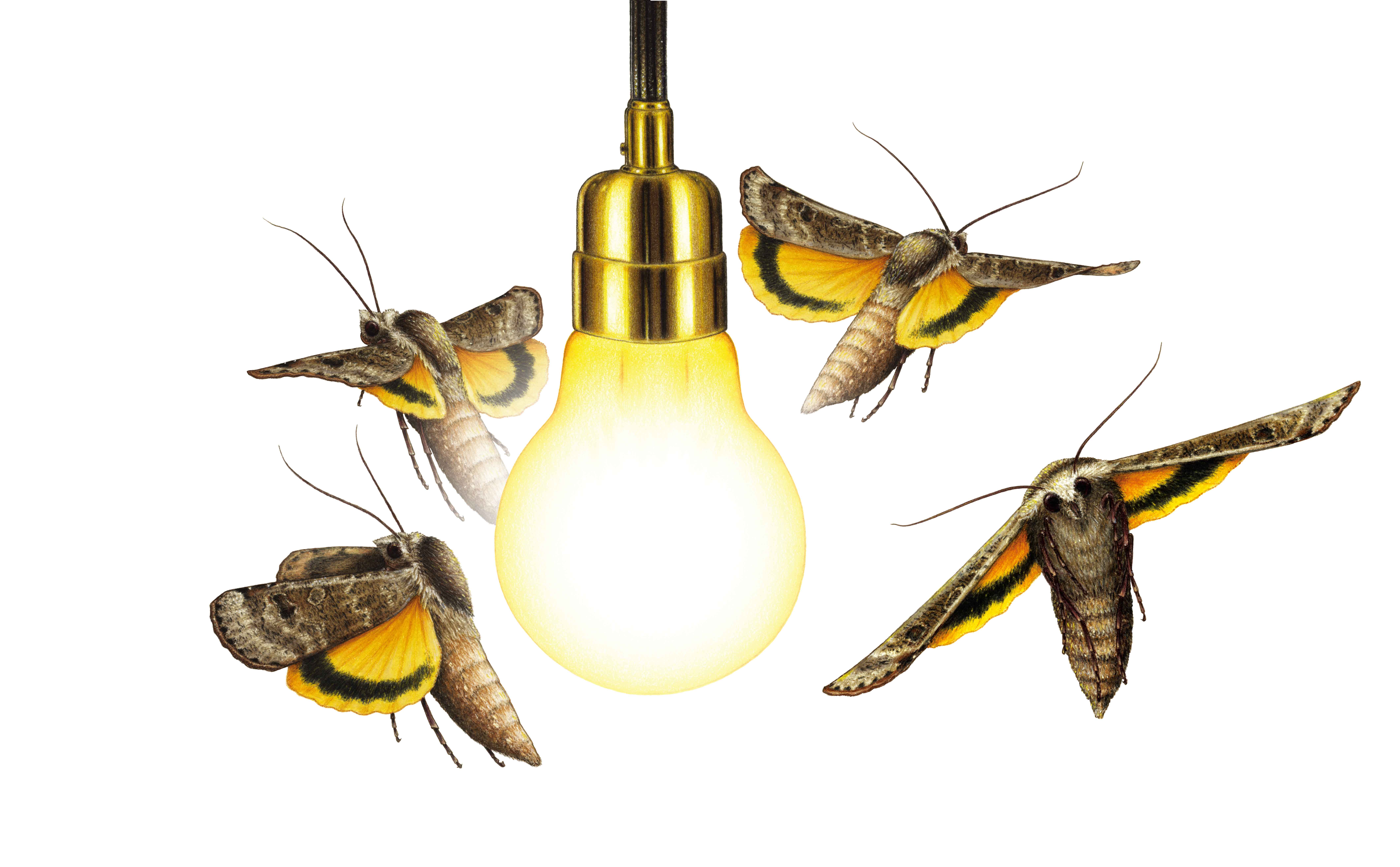
Large yellow underwing moth ( Noctua pronuba )--WITH THE SUN AT YOUR BACK: The tendency of insects to turn their backs toward the light is called the dorsal light response. Bigger animals such as humans can tell up from down based on the pull of gravity sensed directly by the inner ear, among other inputs. Insects’ minute sensory organs and their rapid aerial accelerations prevent a moth or a wasp from distinguishing immediately above from below. As a result, they use the sky’s brightness as a constant that allows them to self-orient by pointing their backs to the heavens—or at least they did before the arrival of human civilizations that always keep the lights on.(Graphic by Immy Smith)
Large yellow underwing moth ( Noctua pronuba )--WITH THE SUN AT YOUR BACK: The tendency of insects to turn their backs toward the light is called the dorsal light response. Bigger animals such as humans can tell up from down based on the pull of gravity sensed directly by the inner ear, among other inputs. Insects’ minute sensory organs and their rapid aerial accelerations prevent a moth or a wasp from distinguishing immediately above from below. As a result, they use the sky’s brightness as a constant that allows them to self-orient by pointing their backs to the heavens—or at least they did before the arrival of human civilizations that always keep the lights on.(Graphic by Immy Smith)

© SCIENTIFIC AMERICAN, A DIVISION OF NATURE AMERICA, INC.ALL RIGHTS RESERVED.